
|
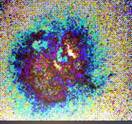
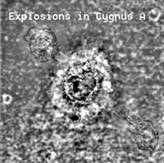
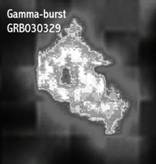
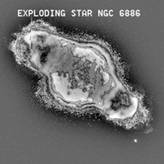
SHELLS SPLIT APART The speed, in which the evolution of structures take place, bringing forth changes from the early phase, that forms more open nuclear structure, to late phase with compact 3D-object at the center of the objects, may vary depending on the circumstances in which the structures are generated within the mother bodies. The systems, which are hurled as fragments from the mother structure, may follow a different time scale of evolution than the structures which evolve while remaining as parts of the spiral arms, or cores of the mother body. The ejected structures are usually more massive than the structures which remain clustered together in the main body of the system. In all cases the end results of the evolution is decay. In cases where the evolution proceeds fast followed by intense activities of structure formation in the next smaller scale, the equilibrium between the inflow and outflow may get disrupted by more rapid flow from the center. In such situations the structures may end their life in catastrophic explosions like in supernovae and gamma-ray bursts. In cases where the equilibrium can be maintained, the structures burn the fuel which remains confined within the shells and live for a longer time. When the fuel is consumed the structures undergo gradual decay while the shells expand outward by venting out hot gases out of the core. The inner structure collapses into a dwarf system. In the case of explosions the shells, that surround the nuclear spiral as cocoon around it, split apart. In most energetic cases, the shells, originally formed of two spiral arms, break apart into two bow-shaped structures and are flung in opposite directions from the center. In some cases the shells may remain intact and expand as a ring for a while before disintegrating. The structures, which evolve following the cascade where larger bodies break into smaller and smaller units, may mature in evolutionary stage in each level of ejection which precede their births. They are more prone to end their life in catastrophic explosions in the end of the cascade. The strongest gamma-ray bursts arise from such processes where violently unstable nuclei of quasars, known as blazars, which lie in the end of such a cascade of ejections, end their life as hypernovae. Such high energy events generate elementary particles which combine to form new gases needed for the renewal of the universe. Read more… |
|
Decay by fragmentation |
|
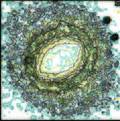
Fragmentations of the shells in the elliptical galaxy NGC 5493. The innermost shell containing the inner spiral is highly destabilized and breaking apart. Enlarged image…. |
|
As the structure gets older and the fuel supply to energize the structure dwindles, the shells encompassing the inner spiral gradually become unstable and fragment into smaller pieces. In the end it may end up in creating debris of fragmented shells surrounded by small structures More... |

|
Decay followed by expanding shells |
|
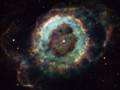
A sun like star is dying by transforming into a white dwarf. The image is of NGC 6369 where the outermost shell is flying apart as two bow-shaped structures while the inner shell is expanding as a ring containing the dwarf star at its heart. Enlarged image…. |
|
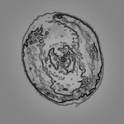
In some cases after consuming the fuel the system will shrink into a small structure while throwing away the surrounding shells which once protected the inner spiral as cocoons around it. More... |
|
Death by explosion sta |
|
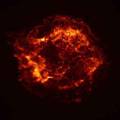
A massive star Cassiopeia A has undergone an explosion which has catastrophically disrupted the structure of the shells. This supernova occurred in 1667. Enlarged image…. |
|
In objects where the burning inside the core occurs too fast and the equillibrium between the outflowing hot gases to the shells and the inflowing cooler gases from the shells to the center can not be established, the system may explode by catastrophically disrupting the shells as in supernovae. More... |
|
Decay by creating jets and blobs |
|
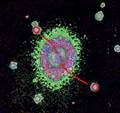
The most energetic radio galaxy Cygnus A which shows strong radio jets emerging from the centre. The red lines show the radio jets and the objects in red circles are the radio intense ejected blobs. Enlarged image…. |
|
In many cases the shells split apart into two bow-shaped structures and expand outward while throwing jets in opposte directions. These jets follow ejected blobs. In such systems one sees disintegration of structures by creating blobs of structures flying around. More... |