


|
OUTFLOW RETURNING AS INFLOW The cosmic structures in all scales evolve in the same universal way. Every structure, whether it is a super-super-cluster of hundreds of millions of light years in size, or a dwarf star which is millions of billions times smaller than that, all can be described as consisting of an external feature, a core and a nucleus. All these three components bear similar morphological aspects in all cosmic objects. The external feature consists of two main spiral arms flung on opposite side, like what is seen in a barred spiral galaxy. The core is shaped by the wounding of the spiral arms around the nucleus forming ring-like structure. In the nucleus lies a three-armed spiral whose arms twist in 3D-space to create compact objects while tightening the arms around the center. The stages of evolution of objects can be characterized by the nature of these three different regions. In an early stage of evolution the external features dominate and the system consists mostly of hierarchically embedded spiral structures. As the structures evolve the core and the nucleus become more and more pronounced while the external spiral forms start disappearing. In the end a 3D star-like structure forms inside the nucleus while the rings break apart into smaller bodies. Thus a cluster, containing a central massive object surrounded by smaller bodies, is created. At every stage of this process of evolution all structures shred off smaller bodies from the region undergoing major changes. The evolution is driven by a mechanism of channeling back the outflow from the centre towards the nucleus again. Thus by feeding back ouflowing material as fuel the cosmic bodies seek to attain a stage of equilibrium when they can self-sustain their existence by feeding on the material poured out of the centre. This sets the process of transforming lighter material into denser elements generating outpouring of immense energies through thermonuclear reactions. The mechanism of outflow and inflow are universally organized in the same way through four main mouths of ejections. They lie in two opposite ends of the major and minor axis of the elliptical ring which defines the core. Read more… Black-hole replaced by a ”magic-wand” of creation of the universe |
|
Early stage of evolution |
|
Stage when the rings are most active |
|
Stage when nucleus is most active |
|
Stage when decay begins |
|
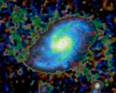
A new born galaxy ejected from NGC 4151. As the galaxy will move away from the mother structure, the ejected three armed structure will evolve while the spiral arms will wrap into ring-like structure enclosing the three armed spiral inside the nucleus. Enlarged image…. |
|
The evolution of ejected structure starts as a three armed open structure containing two external spiral arms. The gas flowing out of the centre embolden the external spiral arms and generate energetic activities in the arms. In a galaxy this translates into star formation in the spiral arms. As the structure moves away from the mother structure it evolves into a system very similar to barred spiral around a nuclear bar. More... |
|
Blazar 3C279 posseses very active nucleus. It is among the most violently variable quasars, which are nothing but ejected high redshift objects. Enlarged image…. |
|
As the structure evolves from the barred spiral it develops fractally embedded structures where smaller spiral lies in the womb of larger one. The arms of these spirals get more and more wrapped into ring structures as one approaches the core. In the core they form fractally embedded rings where smaller rings lie inside larger rings. These rings are emboldened by the gases which flow out of the center and become the regions of energetic activities like starformation in the core of galaxies. More... |
|
After the phase of the formation and ejection of structures which occurs in the rings , the system becomes even more compact and the arms of the 3D spiral structure enclosed within the rings twist to form a 3D knot structure. This inner 3D structure forms several outpouring mouths trough which hot gases profusely pour out from the centre to destabilize the rings. The rings may break apart by forming a cloud of smaller structures around the core. At this stage the nucleus becomes the main energy source and the centre of main activites. More.... |
|
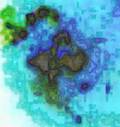
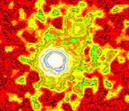
The core of the Perseus cluster of galaxies with NGC 1275 at its centre. The galaxy formation and ejections occur in the ring structure which surrounds the massive elliptical galaxy lying at the centre. Enlarged image…. |
|
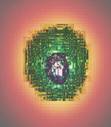
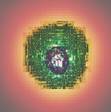
An old star Betelguese or Alpha Orionis which is undergoing decay. It is known as a red supergiant star which is much colder than the new born blue stars The hot gases trapped inside the inner shell leaks out through several vents and expand outward from the centre creating a red nebulous sphere. Enlarged image…. |
|
After the phase of equillibrium between the outflow and inflow is reached, and the cosmic bodies become independent of the outside supply of gases for their survival they show most intense activities and energy outpouring. When the gases trapped inside the shells are used up in producing energies as emissions in different wavelengths the core shrinks and collapses by venting out hot gases from the centre. These outpoured gases expand to create nebular structures around the colder central object. In cases when the energy outpouring becomes too intense the structure may explode as in the case for supernovae and gamma-ray busrts. More.... |